How Much Does a Space Capsule House Cost
A realistic Space Capsule house cost is never a single number. Recent supplier-published benchmarks put factory-gate pricing for small studio capsule homes around $12,000–$18,000, one-bedroom units around $19,000–$27,000, two-bedroom units around $28,000–$40,000, and larger custom builds starting around $40,000. At the same time, marketplace listings show cheaper entry-level pods or simplified units in the roughly $5,200–$10,580 range, while mainstream hospitality-grade offers often sit around $22,000–$31,500 FOB. A U.S. distributor, meanwhile, says its models start at $23,000 and run up to $70,000, with fully installed budgets typically landing around $35,000–$100,000depending on size and logistics.
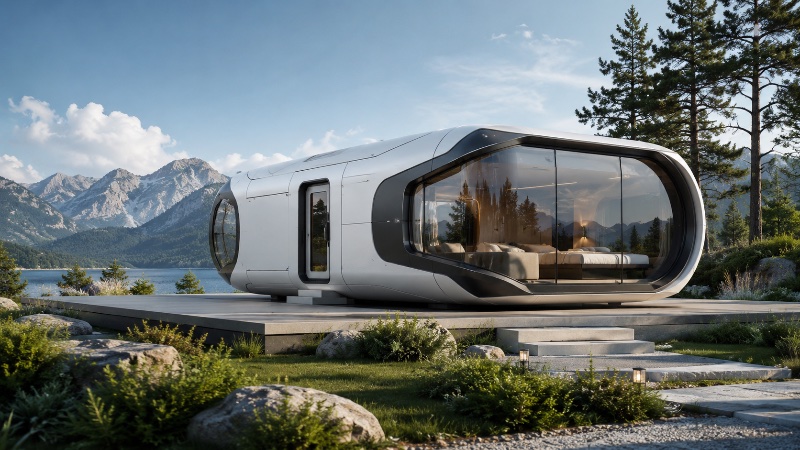
For a buyer evaluating a Qingdao Thyssen steel Space Capsule house, the published product profile is clearly not a bare shell. Qingdao Thyssen Steel’s official page lists 200 sq.ft, 300 sq.ft, and 400 sq.ft configurations, each with 1 bedroom and 1 bathroom, plus water/heating/ventilation systems, air conditioning and heating, electrical hook-up and sewer joints, smart controls, smart locks, automated blackout curtains, and 270° panoramic insulated windows with skylight. That means a serious Space Capsule house manufacture quotation should be benchmarked against the mid-market or premium-complete-unit bands, not the lightest online “pod only” offers.
The most important open-ended assumptions in this report are these: currency is USDunless noted; factory-price discussions assume an FOB China baseline unless otherwise stated; land cost, permitting, and major utility-network extension are excluded unless explicitly added; and June 2026 freight references use standard-ocean-lane benchmarks, not guaranteed oversize/project-cargo rates. That last point matters because Qingdao Thyssen Steel’s published 300 sq.ft and 400 sq.ft models are 28 ft x 11 ft x 11 ft and 38 ft x 11 ft x 11 ft, while a standard 40′ high-cube container has a 2,340 mm door width and 2,577 mm door height. In practice, many assembled capsule units will require flat-rack, breakbulk, or partial-disassembly strategies rather than ordinary containerized loading. A comparable GLAMNI model at 8,500 mm x 3,300 mm x 3,300 mm explicitly lists shipping by 40′ HQ or 40′ FR, which reinforces that logistics mode is a first-order cost driver, not a footnote.
| Cost layer | Practical working range | What the number usually means |
|---|---|---|
| Entry/basic pod or simplified shell | $5,200–$10,580 | Lowest-end online market offers; often not directly comparable to hospitality-ready units |
| Small studio complete unit | $12,000–$18,000 | Factory-built small capsule home |
| One-bedroom complete unit | $19,000–$27,000 | More typical buyer benchmark for a usable single-room living unit |
| Two-bedroom or larger complete unit | $28,000–$40,000+ | Larger or more configured unit |
| Premium/distributor range | $23,000–$70,000 | Branded, export-supported or more customized packages |
| Delivered-and-installed working budget | $35,000–$100,000 | Includes logistics, setup, and location effects |
Table note: ranges synthesize official manufacturer guidance, manufacturer listings, and distributor guidance rather than a single standardized product.
Market evidence and assumptions
The honest answer to “How much does a Space Capsule house cost?” is that buyers are usually mixing three very different price concepts: factory price, landed price, and ready-to-operate project cost. Factory price covers the unit itself. Landed price adds export packing, ocean logistics, customs, port handling, inland transport, and sometimes crane work. Ready-to-operate cost adds local site preparation, foundation, final hookups, local labor, inspections, and a contingency for after-sales or spare parts. That is why low headline online prices often disappoint on arrival: the shell may be cheap, but the installed project is not. GLAMNI expressly separates base capsule prices from shipping, site work, foundation, utility connections, and optional upgrades, and Vessel Homes USA does the same by breaking out shipping, tariffs, trucking, crane, and local installation.
The extra-cost bands published by suppliers are useful because they make the hidden math visible. GLAMNI’s cost guide places site prep at $500–$5,000, foundation at $800–$5,000, transportation and delivery at $1,200–$5,000+, crane and installation crew at $1,500–$4,000, utility connections at $700–$3,000, and permits and inspections at $300–$2,000. Vessel Homes USA gives a stronger U.S.-specific signal by showing shipping to a U.S. port at about $3,500–$7,500, trucking to site at $2,000–$5,000, and crane rental at $1,000–$3,000, while emphasizing that local installation labor is not included in its quote.
Taxes are equally location-sensitive. In the United States, one recent CBP ruling for a metal prefabricated housing structure from China classified under 9406.90.0130 states a 2.9% ad valorem duty rate; actual entries should still be confirmed with a broker because final classification and trade measures can vary by product configuration and origin. In the European Union, the European Commission says the standard VAT rate cannot be lower than 15%, though the exact rate is set by each member state. In the United Kingdom, the stated standard VAT rate is 20%. For commercial buyers, the operational impact of VAT may differ from the cash-flow impact, because VAT treatment depends on the buyer’s registration structure and jurisdiction.
Local labor can also move the budget meaningfully. As a U.S. benchmark, the Bureau of Labor Statistics reports median annual pay of $46,050 for construction laborers and helpers, $62,350 for electricians, and $62,970 for plumbers, pipefitters, and steamfitters in May 2024. On a simple 2,080-hour divisor, that is roughly $22/hour for basic construction labor and about $30/hour for electricians and plumbers before local markups, mobilization, burden, overtime, or contractor margin. That is one reason final hookup and commissioning costs can widen fast in high-cost metros, remote tourist zones, or island markets.
If you are writing or quoting around Qingdao Thyssen steel, the safest cost posture is to treat the official Qingdao Thyssen steel Space Capsule house specification as a complete, export-oriented hospitality product and then budget separately for logistics and site realization. That framing is more rigorous than comparing it to the lowest visible internet pod listings, because Thyssen’s official product set is larger, more system-heavy, and explicitly aimed at modular living solutions rather than bare enclosures.
Cost breakdown and sample budgets
The table below is a modeled analytical breakdown, not a direct supplier quote. It assumes a mid-spec 28–38 sqm capsule unit comparable in scale to a Qingdao Thyssen 300 sq.ft model or a GLAMNI RT S50-type product, with finished bathroom, HVAC, insulated panoramic glazing, smart controls, and export readiness. The numbers are calibrated to the market ranges above and to published supplier feature lists and add-on bands.
| Component | Modeled per-unit cost | Share of modeled delivered budget |
|---|---|---|
| Structure and frame | $5,600 | 14.7% |
| Exterior materials and finish | $2,800 | 7.3% |
| Insulation and weatherproofing | $1,900 | 5.0% |
| Windows, doors, and panoramic glazing | $3,000 | 7.9% |
| Interior fit-out and bathroom | $5,600 | 14.7% |
| MEP, HVAC, and smart systems | $4,100 | 10.8% |
| Export packaging and bracing | $700 | 1.8% |
| Ocean, port, and inland transport | $5,500 | 14.4% |
| Installation and crane work | $2,700 | 7.1% |
| Local labor and utility hookups | $5,500 | 14.4% |
| Warranty and spare-parts reserve | $700 | 1.8% |
| Modeled delivered subtotal | $38,100 | 100.0% |
Table note: modeled around published supplier price bands, supplier-stated features, and published logistics/install adders; taxes are excluded.
The next table shows how project size changes economics. These are again modeled budgets, intended as practical planning numbers for SEO content, sales enablement, or pre-quote budgeting. They assume progressively better freight utilization, repeat foundations, learning-curve savings, and stronger purchasing leverage at higher volume. Scale discounts are consistent with marketplace evidence that some vendors quote materially lower per-unit prices at larger order tiers. One Alibaba result, for example, showed pricing moving from $50,700 for 1–9 units to $43,400 for 10–49, $36,000 for 50–99, and $34,000 for 100+, which is not a market average but does clearly demonstrate the direction of volume economics.
| Project scenario | Units | Modeled per-unit budget before tax | Project subtotal before tax | U.S. base-duty illustration on FOB value only |
|---|---|---|---|---|
| Small pilot resort or demo cluster | 4 | $44,100 | $176,400 | +$3,016 |
| Medium glamping rollout | 12 | $38,100 | $457,200 | +$8,352 |
| Large multi-unit hospitality deployment | 30 | $33,800 | $1,014,000 | +$19,140 |
Table note: U.S. duty illustration assumes 2.9% on factory value only and excludes any additional trade remedies; EU and UK cash outlay would typically be higher at import because VAT applies.
For most buyers, the single biggest budgeting mistake is treating the factory quote as the project quote. A useful rule of thumb is that for a one-off or 1–5 unit purchase, the factory unit may represent only about two-thirds of the real delivered budget, especially when the unit is large, the site is remote, or crane/permit conditions are difficult. That ratio usually improves in 6–20 unit projects and improves again once a 21+ unit rollout allows repetition, freight consolidation, and standardized installation procedures. This is exactly why any professional Space Capsule house manufacture negotiation should ask for a component-separated quotation rather than a single round number.
Regional variation, ROI, and buyer strategy
Regional price variation starts with freight. As a June 2026 benchmark, Freightos lists current 40′ route indices of about $4,836 from China/East Asia to the U.S. West Coast, $6,558.20 to the U.S. East Coast, $4,189 to Northern Europe, and $5,438.60 to the Mediterranean. Freightos also states that its FBX indices are calculated from rolling short-term spot tariffs and surcharges using 50–70 million price points per month, which makes them a credible directional benchmark. But for capsule houses, route price is still only part of the story, because oversize handling, port lifting, destination permits, and jobsite access can dominate the gap between a standard-box estimate and the actual transport invoice.
Here, product geometry matters as much as geography. Qingdao Thyssen Steel publishes 28 ft x 11 ft x 11 ft and 38 ft x 11 ft x 11 ft dimensions for its larger capsule models, while Maersk’s 40′ high-cube spec shows 2,340 mm door width and 2,577 mm door height. A GLAMNI model with nearly identical width and height (3,300 mm x 3,300 mm) openly lists 40′ HQ or 40′ FR shipping. The practical implication is straightforward: if the supplier is not shipping in parts, oversize cargo planning is probably required, and that generally raises both ocean and inland transport complexity.
Specification changes also push budgets quickly. Qingdao Thyssen’s published feature stack already includes panoramic insulated glazing, HVAC, smart controls, automated blackout curtains, and utility interfaces; GLAMNI’s RT S50 specification adds 100 mm polyurethane insulation, LOW-E or insulated glass, intelligent access control, branded sanitary ware, Gree central air conditioning, optional electric floor heating, anti-freeze piping, projector, and fire/smoke alarm. That means customization should not be thought of as “paint color only.” In real buying, customization can mean glazing upgrades, climate package, bathroom grade, smart-home stack, or off-grid prep, all of which materially change manufacturing and transport economics.
ROI, therefore, should be modeled from the fully loaded installed cost, not the FOB number. If a small pilot unit lands at roughly $44,100 before taxes and a resort operator achieves an average daily rate of $120 at 55% occupancy, annual gross room revenue is about $24,090, implying a crude payback of about 1.8 years before operating expense, tax, maintenance, platform fees, and financing cost. That is not a forecast; it is simply an illustration of why distinctive capsule accommodation can look attractive to campsite, glamping, and boutique-resort operators. The design premium matters because the guest is paying for both shelter and experience. This is one reason so many manufacturers position capsule products toward hospitality and short-stay uses rather than purely residential utility.
Financing strategy should follow the same logic. It is usually cleaner to finance the imported unit and the local site works as two separate budget buckets, because the risk, timing, and contractors are different. It is also worth asking the manufacturer to quote the same specification under multiple Incoterms—typically EXW, FOB, and CIF, and sometimes DAP or DDP—because Trade.gov notes that Incoterms define which party pays for and manages shipment, insurance, documentation, customs clearance, and other logistics responsibilities. GLAMNI’s own RT S50 page already shows that some suppliers are comfortable quoting EXW, FOB, and CIF, so buyers should use that flexibility instead of accepting one opaque landed number.
The strongest negotiation points with a Space Capsule house manufacture partner are usually the least glamorous ones. Ask for a bill-of-materials-level breakout for frame, glazing, insulation, bathroom package, HVAC brand, and smart system; ask whether a partially disassembled shipping plan can convert flat-rack/breakbulk exposure into a more efficient transport mode; ask for lead time in writing; ask for spare-parts scope; and ask what “warranty” actually means in response time and exclusions. Luban says typical lead time is 30 days post-deposit and warranty is 3–5 years; GLAMNI’s FAQ says 3–5 years as well, while one GLAMNI S50 product page advertises a 30-year warranty, 15–30 day lead time, and shipping by 40′ HQ or 40′ FR; Vessel Homes USA says manufacture and shipment can take 10–12 weeks. Those differences are exactly why negotiation must move beyond headline price.
Procurement timeline
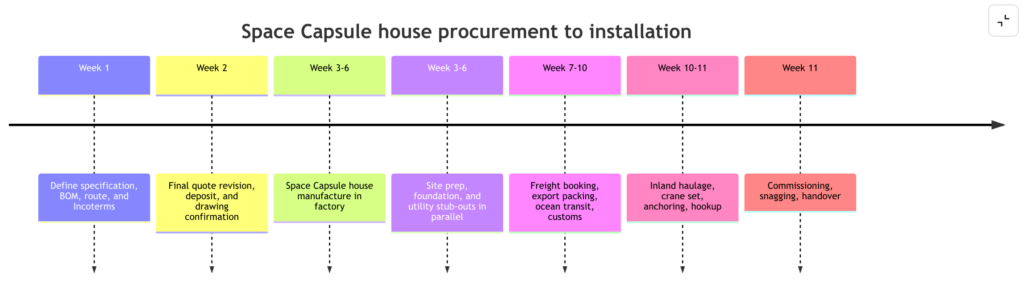
A sensible procurement timeline for a Qingdao Thyssen steel Space Capsule house or comparable capsule project usually spans specification, quote revision, deposit, shop drawings, production, parallel site preparation, freight booking, customs, inland haulage, crane set, hookup, and commissioning. Supplier-published timelines vary: Luban cites about 30 days post-deposit, GLAMNI’s S50 page cites 15–30 days, GLAMNI’s broader cost guide says many orders are ready for shipping in 6–12 weeks, and Vessel Homes USA cites 10–12 weeks to manufacture and ship. GLAMNI also says on-site crane setting may take 1–3 days. The visual timeline below is therefore best read as an illustrative planning sequence rather than a universal promise.